
Throughout Vietnam’s history, the traditional Vietnamese house has served not only as a place of shelter but also as a vessel of cultural continuity. Its architectural language, rich with symbolism, regional diversity, and ecological wisdom, reveals much about the values, lifestyles, and spirit of the Vietnamese people. Today, in the heart of Saigon, Hội An Sense pays homage to this timeless tradition, inviting guests to dine within a space that echoes the grace and soul of Vietnam’s ancient homes. This experience captures the essence of a traditional Vietnamese house in its most elegant form.

Regional expressions of the traditional Vietnamese house
Vietnam’s geography spans a long vertical stretch, and with it, traditional Vietnamese houses vary subtly yet meaningfully from north to south. Each traditional Vietnamese house is a reflection of its environment, culture, and the people who call it home.
Central traditional Vietnamese house: modesty in the face of nature Northern traditional Vietnamese house: harmony and heritage: harmony and heritage
In the north, where seasons are distinct and the culture strongly tied to Confucian principles, traditional Vietnamese houses emphasize order and ancestral reverence. These homes often feature three compartments: a central altar room and two side chambers. Wooden beams and yin-yang tiled roofs, arranged for optimal airflow and insulation, reflect a deep understanding of natural balance. Courtyards are common, symbolizing connection between the home and the earth, a principle rooted in both feng shui and agricultural tradition. Each northern traditional Vietnamese house serves as a sanctuary of familial unity and spiritual alignment.
Central traditional Vietnamese house: modesty in the face of nature Central Vietnamese traditional house: humble before nature
Homes in the central region, where floods and storms are common, are designed with resilience and humility. Built lower to the ground and using local stone or laterite, these structures prioritize practicality. Yet they do not forsake beauty. Intricate carvings on wooden panels and elevated altars speak to a people who revere both spirituality and craftsmanship. The architecture here demonstrates how a traditional Vietnamese house harmonizes with its challenging environment while preserving elegance and purpose.
Central traditional Vietnamese house: modesty in the face of nature Southern traditional Vietnamese house: openness and light: open and gentle
In contrast, the tropical climate of southern Vietnam has inspired an architectural style that is open and expansive. Traditional homes in the Mekong Delta are often made of coconut wood and palm leaves, with airy verandas and open interiors that invite light and wind. The lifestyle here is more relaxed, and so is the architecture. Welcoming, generous, and in tune with the riverine landscape. These homes represent a different yet equally vital expression of the traditional Vietnamese house, reflecting openness, hospitality, and adaptive design.
Ancient Vietnamese architecture in historical homes
To explore ancient Vietnamese architecture in person, visitors can seek out historic houses that have preserved the aesthetics and spirit of this heritage. Each one is an embodiment of the traditional Vietnamese house, adapted across time and region.
Dong Ngac Village, Hanoi
On the outskirts of Hanoi lies Dong Ngac, a village famous for its centuries-old houses. These houses, with their moss-covered thatched roofs and carved wooden beams, are living museums of northern Vietnamese culture. Their layout revolves around ancestor worship, revealing a deep respect for family and tradition. Each is a shining example of the enduring values associated with the traditional Vietnamese home.
Tan Ky Old House, Hoi An
Perhaps one of the most iconic examples of a traditional Vietnamese house is the Tan Ky Ancient House in Hoi An. Over 200 years old, the house seamlessly blends Vietnamese, Chinese and Japanese architectural elements. With its wooden balconies, arched doors and floor tiles imported from China, it tells the story of Hoi An’s multicultural heritage during its days as a thriving trading port. It remains an important testament to ancient Vietnamese architecture and how the Vietnamese-style house has adapted to global influences.
The House of Công Tử Bạc Liêu
The Mekong Delta home of the famous Southern aristocrat Cong Tu Bac Lieu showcases a luxurious interpretation of Southern Vietnamese style. Combining French colonial design with traditional materials, the house reflects the elegance of a bygone era while retaining local character through its layout and decoration. It represents a fusion that enriches our understanding of the traditional Vietnamese house as both a cultural symbol and a personal expression.
Experience ancient Vietnamese architecture at Hoi An Sense
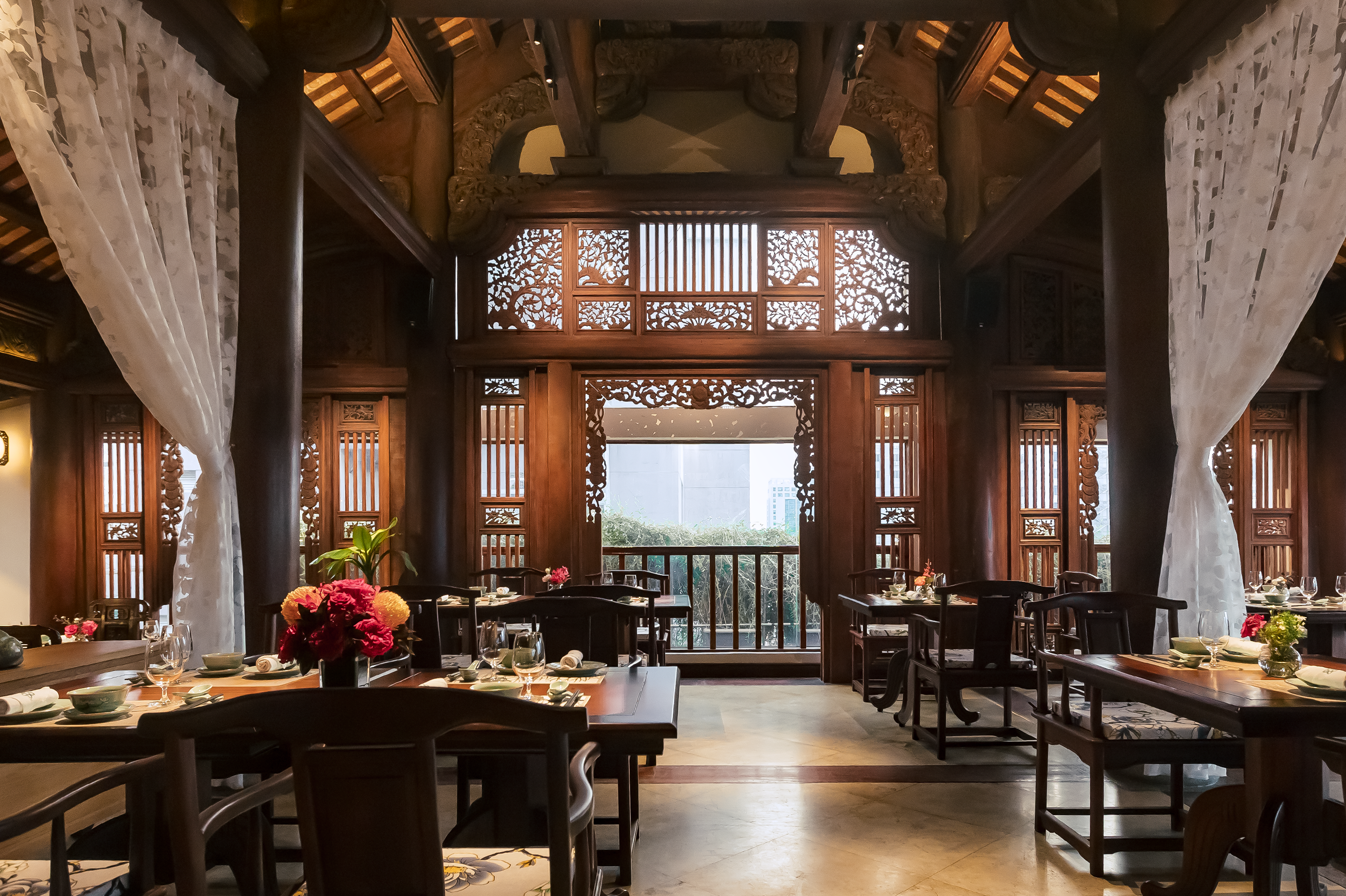
At Hoi An Sense, the traditional Vietnamese house is not merely evoked. It is meticulously reimagined. The space is anchored by a large wooden structure, with soaring ceilings and sturdy wooden beams crisscrossing above like the quiet skeleton of an ancient ancestral home. Each column, each beam is more than just a structure. It is a wooden narrative, hand-carved with folk motifs that speak to Vietnamese mythology, daily life and enduring cultural values. This is a living display of the Vietnamese-style house, rendered in exquisite detail.

This artisanal craftsmanship gives Hoi An Sense a soulful atmosphere. The carvings, made by skilled artisans, invite guests to contemplate the heritage they represent, from lotus flowers symbolizing purity to scenes of village life capturing the rhythms of tradition. These elements create not only visual beauty but also a sense of continuity with the past, echoing the spirit of ancient Vietnamese architecture.
The layout reflects the architectural flow of a traditional Vietnamese house. Open yet intimate, balanced yet expressive. Soft light pours through the wooden lattice, and the quiet courtyard frames the dining experience with serenity. This is not a mere backdrop for cuisine. It is an active cultural presence, elevating each meal into a moment of connection with Vietnamese heritage. In this space, every detail serves the mission of honoring the traditional Vietnamese house in both spirit and structure.
A traditional Vietnamese house experience with fine dining at Hoi An Sense
In an age where modernity can sometimes overshadow tradition, Hoi An Sense stands as a sanctuary of Vietnamese identity. It celebrates the traditional Vietnamese house not just as a design, but as a philosophy. One of balance, beauty and belonging. In doing so, it also preserves and celebrates the Vietnamese style house in its most authentic form.
Stepping into Hoi An Sense is stepping into the heart of Vietnam’s cultural heritage. Whether you are a foodie or a seeker of authentic experiences, the space invites you to rediscover the elegance of Vietnamese-style houses and the timeless charm of ancient Vietnamese architecture, one charming meal at a time. The traditional Vietnamese house is not a relic. It lives and breathes at Hoi An Sense, inspiring a deeper appreciation of the artistic and architectural soul of Vietnam.